Welcome to the Kang Research Group
Interested in joining our group? Prospective postdoctoral researchers, graduate students, and undergraduate students are encouraged to visit the Join Us page for information on research opportunities and application details.
Our group is dedicated to exploring some of the most fundamental questions in theoretical physics, focusing on Quantum Chromodynamics (QCD) and strong interactions. Our research falls under the [hep-ph] category on arXiv.org: high-energy physics – phenomenology, which studies how the fundamental laws of nature manifest in observable phenomena.
We work broadly on QCD theory and phenomenology, with close connections to the experimental programs at the Large Hadron Collider (LHC), the Relativistic Heavy Ion Collider (RHIC), and the future Electron–Ion Collider (EIC). We also actively pursue emerging directions in quantum simulation, tensor-network methods, and machine learning for nuclear and particle physics.
We are part of the SURGE Collaboration, a Topical Collaboration in Nuclear Theory funded by the US Department of Energy, Office of Science, Office of Nuclear Physics, as well as the California EIC Consortium. By bridging theory and experiment, we aim to unlock new insights into the strong interaction and the properties of strongly interacting matter.
Our research focuses on several key areas in theoretical high-energy nuclear and particle physics:
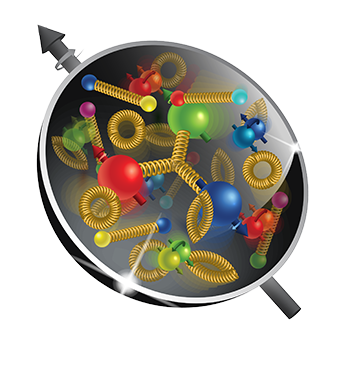


Our research builds on advanced theoretical frameworks, such as Soft Collinear Effective Theory (SCET) and QCD factorization, to develop rigorous tools for studying QCD dynamics. In parallel, we leverage state-of-the-art computational methodologies, including quantum simulations and machine learning, to tackle real-time dynamics, non-perturbative challenges, and the analysis of complex datasets. These complementary approaches expand our understanding of the strong interaction and enable deeper insights into high-energy nuclear and particle physics.
The group is led by Professor Zhongbo Kang, a faculty member in the Department of Physics and Astronomy at UCLA. Professor Kang is a recipient of the Friedrich Wilhelm Bessel Research Award from the Alexander von Humboldt Foundation and the National Science Foundation (NSF) Faculty CAREER Award for his research contributions. He has also been recognized with the Teacher of the Year Award, i.e., the Abelmann Award for teaching excellence, for his commitment to teaching and mentoring.
Prof. Kang is affiliated with the Mani L. Bhaumik Institute for Theoretical Physics, the UCLA Center for Quantum Science and Engineering (CQSE), and the Center for Frontiers in Nuclear Science (CFNS) at Stony Brook University and Brookhaven National Laboratory. Before joining UCLA, Professor Kang served as a staff scientist in the Theoretical Division (Group T-2: Nuclear and Particle Physics, Astrophysics, and Cosmology) at Los Alamos National Laboratory.
We are committed to training the next generation of physicists. Graduate students, postdocs, and undergraduates in our group gain hands-on experience in theoretical methods, numerical simulations, and computational tools. Our alumni are well-prepared to pursue careers in academia, national labs, and industry. We gratefully acknowledge support from: